FirstNarration
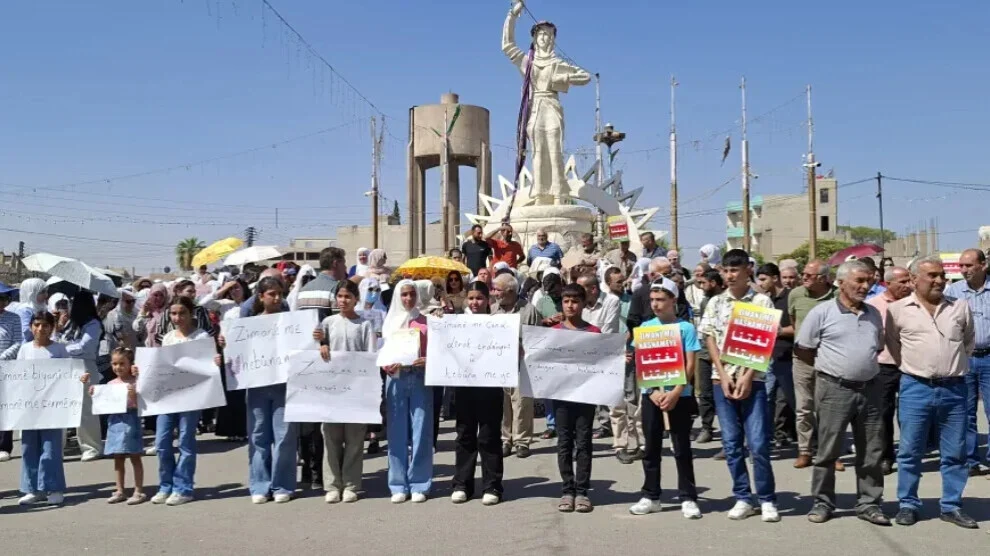
Demonstrations have broken out across Rojava, the Kurdish-majority region in northeastern Syria, with protesters demanding the right to education in Kurdish and other mother tongues. The protests, which have taken place in several cities, reflect growing frustration over educational policies in areas under the control of the Autonomous Administration of North and East Syria.
Residents are calling for schools to offer instruction in Kurdish, Arabic, and Syriac the primary languages spoken in the region rather than imposing a single language of instruction. The demonstrations mark a public challenge to current educational frameworks and signal broader concerns about cultural and linguistic rights.
What sparked the protests
The demonstrations appear to be driven by longstanding grievances over language policy in schools. Rojava is home to a diverse population, including Kurds, Arabs, Assyrians, and other ethnic groups, each with distinct linguistic traditions. Protesters argue that education should reflect this diversity and that children have the right to learn in their native languages.
While the Autonomous Administration has previously promoted multilingual education as part of its governance model, implementation has been uneven. In some areas, Kurdish has become the dominant language of instruction, leading to complaints from Arabic-speaking communities. In others, resources for Kurdish-language education remain limited. The protests suggest that dissatisfaction with these inconsistencies has reached a tipping point.
Demonstrators have gathered in public squares and marched through city streets, carrying banners and chanting slogans in support of mother-tongue education. The protests have remained largely peaceful, though they underscore rising tensions over governance and identity in a region still navigating the aftermath of conflict.
The broader context in Rojava
Rojava has functioned under semi-autonomous governance since 2012, when Kurdish forces took control of the area amid Syria's civil war. The Autonomous Administration has sought to establish a political system based on principles of decentralization, ethnic pluralism, and gender equality, but its authority remains contested both internally and externally.
Language policy has been a flashpoint throughout this period. Under the Syrian government, Kurdish-language education was heavily restricted, and the use of Kurdish in public institutions was often prohibited. The establishment of autonomous governance opened the door to Kurdish-language schooling, but the shift has not been without controversy. Arabic-speaking communities, particularly in areas with mixed populations, have at times resisted what they perceive as the imposition of Kurdish as the primary language.
The region also faces severe material constraints. Years of conflict have left infrastructure damaged, and schools often lack basic resources. Teacher shortages, inadequate facilities, and limited access to textbooks in multiple languages have made it difficult to deliver quality education in any language, let alone several.
Why language matters in this context
Language is not merely a practical question in Rojava it is deeply tied to identity, power, and historical grievance. For Kurds, the ability to educate children in Kurdish represents a reversal of decades of cultural suppression under successive Syrian governments. For Arabic speakers and other minorities, concerns about Kurdish dominance in education reflect fears of marginalization in a system they helped shape.
The issue also has political dimensions. The Autonomous Administration's legitimacy rests in part on its claim to represent all ethnic groups fairly. Protests over language policy suggest that not all communities feel equally represented, and that the administration faces pressure to balance competing demands.
Internationally, the status of Rojava remains uncertain. Turkey views the Kurdish forces that control the region as a security threat and has conducted military operations across the border. The Syrian government has never recognized the Autonomous Administration's authority. In this precarious environment, internal cohesion is critical, and disputes over education risk deepening divisions.
For now, the protests have put the issue squarely on the public agenda. Whether the Autonomous Administration will respond with policy changes, and whether those changes can satisfy the diverse communities involved, remains to be seen. What is clear is that the question of who gets to learn in which language is far from settled in Rojava.